2023-06-16

Dying on the STS Fulton

We've had a few deaths, then a TPK, and a WHOLE lot of close calls in this game. My ideal is that whenever a PC dies the player response is "yeah that makes sense" and no one is surprised. A little upset is fine, heck I sometimes think I get more upset when their PCs die, but I always want it to feel fair.

The first death happened within the first few sessions. Two PCs went to talk to a sleeping dragon, one ignored warnings about not asking to ride the dragon, and the dragon killed her. Everyone on the same page with that one. It also helped to set the stakes for the game early one, which I appreciated.

Next two PC deaths were much later, due to a battle with some naked bandits. This one was a little more random but I think (hope?) fit in with the general potential danger of the setting. I'm also very intentional with trying to make encounters be more than "enemy kill!"

How do these deaths get handled from a play perspective? I have a standing policy of "immediate integration" for new PCs which means the new character shows up, everyone is groovy, and play continues.

The first death was real close to them landing their pod so we just handwaved it "oh yeah new PC was just walking slow." For the next two, the party was way out from their drop pod so I said that the Fulton shoots down new cryo pods because it can detect that someone from the Expedition Party has died. This does not stand up to scrutiny AT ALL because it can be exploited in all kinds of ways by my (very clever) players but we all agreed that it was a cool, hand wavey convenience and not meant to introduce new tools or resources for them. Highlights the importance of everyone being on the same page.

Great so random individual deaths are covered. What happened with the TPK? The party attempted a very bold plan of action to steal an airship from an island of pirates. It was not going well. After two PCs went down Gucci triggered the party's suitcase nuke and that was it, Total Party Kill and Total Pirate Kill. The one downside was that two of the players were not in attendance but I tried and failed to come up with some kind of rationale for how they might have survived the nuke that leveled the island they were on (no refrigerators). I really couldn't think of another way to handle it, and the players were sad but okay, but it still broke the general rule of "if you're not here then your PC is safe." It was a pretty extreme situation, at least.
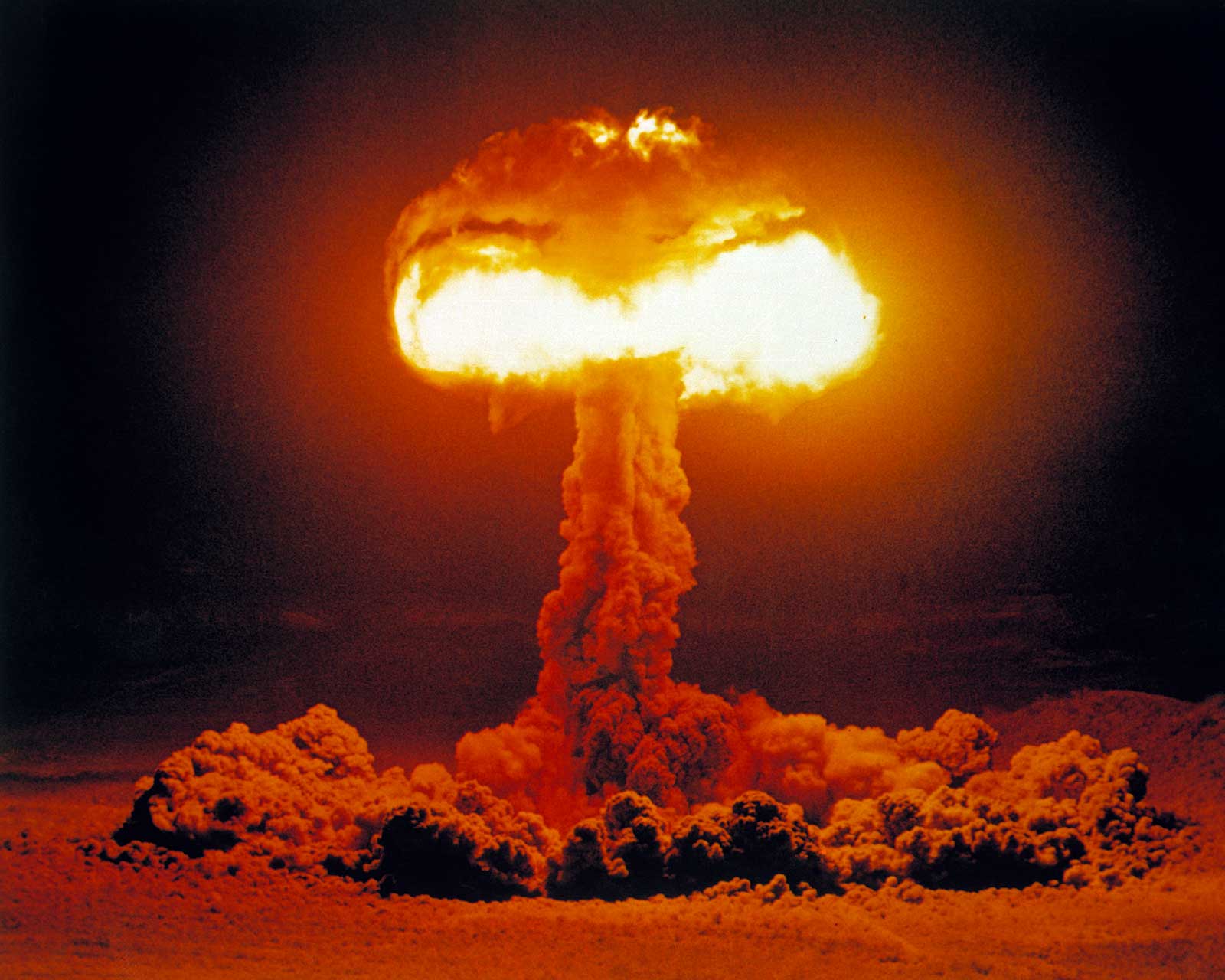
Mushroom cloud from a nuclear explosion rising above a red and dusty-looking plain.
All the best TPKs are player-driven.


In a more standard fantasy game a TPK might just mean you roll up a new party and pick a town to start in but the STS Fulton has an in game method and logic for where new PCs come from. That logic, as represented by the station AI H3LENE, dictated that there would not be a new party thawed out of cryo right away. In fact, 200 years passed in game before H3LENE woke up the next set of PCs. This gave the world a chance to progress and in turn gave the players a new, but still familiar, situation to deal with.

How do you handle TPKs in your game? I liked (and the players liked) the time jump so much that I think I'd go for it in a more fantasy type game as well.


2023-06-06

STS Fulton Campaign

Landing page for the STS Fulton campaign I've been running in Troika.

Session Count:102 (as of 12/28/2023)

Tempo: Every Thursday night

General Posts

Five Things: STS Fulton

Current Party

PCs in bold, NPCs in italics, backgrounds custom written for the campaign
 
Ashlee Leblanc, Procurement Specialist (Peanut Butter)
Clint Thircord, Rocketeer (James)
High Priest Basura Lixo, Scavenger (Sugarplum)
Jason Kelce Gamma12, Organ Incubator (Vegas)
Windril Pondo Tuttus, REDACTED (Juice)
Xerxes Armiger, Psyker (Eclair)

Graveyard

PCs in bold, NPCs in italics
 
Beatrice Bonne Nuit, CorpSec Goon, pissed off a dragon [Session 2 or 3] (Sugarplum)
Antone Bioerde aka "Cook Jackson", Cook, slain by naked bandits [Session 55] (Sugarplum)
Truffle, beloved truffle dog, slain by naked bandits [Session 55] (Sugarplum)
Davian Zatharis aka "Mollusc Man", Scientist, slain by naked bandits [Session 55] (Juice)
Hippolyta Bain, Asteroid Miner, shot by guards while trying to steal SKY KING FULMINARIS's lightning sky ship [Session 70] (Eclair)
al-Jazari, Biosimulant, Torn apart by lightning sky ship minigun [Session 70] (Vegas)
Gucci Zircon, Space Attorney, Vaporized by a suitcase nuke [Session 70] (Sugarplum)
Gray Jackson, Navigator, Vaporized by a suitcase nuke [Session 70] (James)
Jettadiah "Jett", Amnesiac Test Subject, Vaporized by a suitcase nuke [Session 70] (Juice)
Jonnifer Macleod, Engineer, 3rd Class, Vaporized by a suitcase nuke [Session 70] (Peanut Butter)
Abrahan Caseus, Goat Wrangler, Old age / natural causes [between Sessions 70 + 71] (Helpful Waffle)
Finn McCool, Spliced Prisoner [Sharkman], Sliced and diced by angry mole creatures [Session 96] (James)
Billybob Hornton, Goat Wrangler, Lost a goat whistlin' battle [Session 99] (James)


Using Luck in Troika

When I first started running Troika I had a hard time with Luck Tests. I didn't really know how to use them and, with one memorable exception, my players never really got in precarious spots from their luck being low. For context, Luck is a stat that can vary from 7 to 12 and you test it by rolling 2d6 under or equal the stat. Succeed or not, your Luck goes down by 1, making you less likely to succeed on following attempts.

After almost 80 sessions of my STS Fulton campaign I think I've got a better handle on it so figured it's worth sharing what's been working for me. Of course I'm curious to hear what others' experiences or tips are as well!

1. Don't say "Test your Luck"; always ask "Would you like to test your Luck".

The specific phrasing of a Luck Test being a player choice is right in the Troika rules but it's something that I worked to internalize so wanted to repeat it. Luck is a resource that decreases whenever used, making it harder and harder to succeed as it goes down, so it should be up to the player whether they choose to expend it. It gives my players a greater feeling of control over the outcome which is always what I'm going for.

2. Luck is for stuff that happens to you.


Rough equivalent to a saving throw in other systems, used for somehow protecting yourself from dragon breath, airship mounted miniguns, getting horrible spores in your mouth, and other similar events.

3. Luck is also for fixing undefined details


If the players ask a question about the situation that I don't already have an answer to and doesn't follow from establishes facts then I will sometimes ask them if they want to Test Luck to make reality match what they're looking for. "Is this important enough to spend your Luck on it?" For smaller questions I'll often just agree, but testing Luck gives an avenue for finding out if something more impactful goes the player's way.

4. Use Luck to power special abilities


I've primarily used this so far for a couple special abilities for backgrounds, like the ole "pull something momentarily useful out of your sack-o-crap", but there's no reason you couldn't more broadly apply it. Stuff like finicky equipment, unreliable cybernetics, or cold calling potential contacts could all work. I also just put a straight "+1 Luck" in a particularly fortune favored background.

5. Use Luck for supernatural favor

I said "favor" very specifically because it felt too mean (to me) to take away from the meagre Luck reserves that most players seem to have. It's not come up yet (soon!), but I could see giving a bonus over and above the normal Luck cap to represent divine influence or exceptional fortune. Maybe more to come on this one.


2023-02-04

Pulling Punches in Troika

A lot of the follow-on complications in my longish running STS Fulton campaign stem from an incident in a cake shop that escalated very quickly. A critical stage in that escalation involved James' character accidentally killing a town guard. The PC in question attacked with a club, wanting to subdue the guard, but I interpreted it as a killing blow based on the damage. Oops. We talked about it and decided to let it stand, but it never felt quite right. It's come up a few times since in discussion but was intensely relevant during last week's game.

During the session we came up with basically "if it reasonably makes sense you can incapacitate someone" (i.e. the "good plan doesn't require a roll" approach) or that they could try to use Wrestling to restrain someone and then if they could maintain it then they could tie that person up. Still wasn't really satisfied but just had a flash of inspiration so wanted to get it written down.

First thing to note is that all weapons in Troika do damage based on a roll of a d6 and then compared against a lookup table (see below for a sample).

Melee Weapons

d6 Roll ->

1

2

3

4

5

6

7+

Axe

2

2

6

6

8

10

12

Club

1

1

2

3

6

8

10

Greatsword*

2

4

8

10

12

14

18

Hammer#

1

2

4

6

8

10

12

Knife

2

2

2

2

4

8

10

Longsword

4

6

8

8

10

12

14

Mace#

2

4

4

6

6

8

10

Maul*#

1

2

3

6

12

13

14

Polearm*#

2

4

4

8

12

14

18

Shield

2

2

2

4

4

6

8

Spear

4

4

6

6

8

8

10

Staff

2

4

4

4

4

6

8

Sword

4

6

6

6

6

8

10

Unarmed

1

1

1

2

2

3

4

The second bit is how dying works in Troika. If you go below 0, you die instantly. If you hit 0 exactly, your friends have until the end of the round to get you back up above 0 or you die at end of round.

So how do you knock someone out in Troika? A player can decide to pull their punch and take a -2 on their damage roll. If they get their enemy to 0 exactly, the PC knocks them out instead of killing them. 

This makes Clubs decent at subduing, Unarmed the best, and Hammers and Mauls unlikely but possible. It also means it's pretty hard to knock someone out with stabby / slashy weapons. Weapon choice has an impact and while you're trying to knock someone out you're leaving yourself open to getting wailed on. The player also has a choice to make on how many full power hits to do before trying to soften the blow and take a prisoner. All of these are about the right feel I was going for, but will see how it plays and update as needed.


2022-07-06

PomoPomo Write: Radiation

I saw a post from Archons March On about this quarter hour of writing challenge from Library of Attnam, who I was not previously tracking. I’m going to do 25 minutes instead because that’s how long the pomodoro normally goes for and that’s the only way I will actually buckle down and do it.

Anyway!

RADIATION

A good prompt for someone still running a post-post-apocalyptic hard(ish) SF game with at least a possibility for further space travel. There’s a post at Rotten Pulp I’ve been marinating on about a creature called a Contaminant that doesn’t explicitly name radiation but has a lot of the same considerations. There’s also a post from Incunabula about radioactive sorcerer organs (Slumbers) that I used in my last game that springs to mind. They’re real good, go read them! Was going to put a caveat that my players shouldn’t read about the Contaminant but honestly don’t think it would matter.

How will I use radiation in my game? I’ll probably utilize Contaminants in certain areas tied to certain threads (secrets). The post itself has a lot of good examples of telegraphing danger that are broadly applicable for any kind of invisible hazard. The negative effects of being in the same space as such a creature (e.g. blurry vision, heat, bloody cough, etc) are broadly applicable to other sources as well.

Where a Contaminant is a mobile hazard, more fixed and difficult to bypass blockers could be used in dungeons to block off areas of interest. Power leaks, radioactive explosive residue, or alien technology are all possible emitters. In a tech-poor environment like my players are in, these might hopefully inspire creative use of limited resources to bypass. A fixed locale also lets you use more environmental warning signs like red trees, strange spider webs, or other animal tweaks.

How do you mechanically represent accumulating radiation damage? The first thought I had was clocks. Maybe you have three levels of clock like this:

Minor Effects (2-4 slices)

Moderate Effects (6-8 slices)

Severe Effects (12 slices)

All three clocks get filled concurrently with exposure so a minor effect will pop off earliest to clue the players in that they are in a bad spot. When a clock fills and the player suffers an effect the clock resets and starts filling again. Rolls on effects tables are increased based on how many conditions are currently affecting the player (e.g. two Severe Effects gives a +2 on your next Severe roll).

I’d make some tables of effects but I’m already a bit over time! Oops.

Oh but you should also totally make a dragon with radioactive breath.


Shin Godzilla breathing his radioactive breath.
Shin Godzilla was so incredible.

Reflection

This is a good exercise that I am woefully bad at executing. I did a 25 minutes timer and I still used my “take a short break” five minutes to finish. Without the tomato I would probably never get anything written at all! It took me a while to get to something that was exciting but once I got to the clocks I feel like that might be worthy of expansion with some tables and maybe a little more detail. Maybe next time.

2021-08-20

A Rasp Of Sand Speedrun

I am going to be running a one-day A Rasp Of Sand (by Dave Cox) speedrun this Saturday. I'd been meaning to write a play review of A Rasp Of Sand since we finished our campaign a while ago. Since then, I've had the chance to give my input to a friend writing a review so not going to worry about the details there. I will note that I love this game a ton, only made very slight tweaks, and it does what it says on the tin really well.

For context in terms of this post however the general outline of our campaign was:

Duration: ~5-6 months, roughly weekly sessions of ~2h length
Playspace: Maps, characters, and notes in roll20, jitsi for video/voice
Generations: 4
Extent Reached: end of level 1 (Gen 1), died first room (Gen 2), past the reef gate (Gen 3), The Deep Queen (Gen 4, returned crown)
Experience: 150xp per room explored, awarded on descent
Party at End: (Gen 4) Academic 14, Cook 10, Fisher 11, Slug Farmer 11

Also holy crap I had forgotten the Academic was level 14! Snorting artifacts for sand (XP) is a hell of a drug. Also my buddy Vegas made me a thank you card afterwards with the most adorable art of a CHUM and it melts my heart every time I see it.


Pen and crayon drawing of a short, round little fish person creature. They have big bug eyes, mouth slightly agape in a friendly / clueless expression, and a necklace with two skulls on it. They are holding a long spear and are mildly threatening and welcoming at the same time.
Chum, by Vegas


We talked for a bit after the end about how the game encouraged player expertise and gave a different vibe in terms of lethality. Yes, you can die pretty easily but also that’s fine! gg go next! The driver in not dying is not preservation of character but that next bit of information that you can glean to make the next run easier. As Gen 4 continued the players did start to become more careful with their characters but that could have been a function of time spent playing (Gen 4 took by far the most time) or perhaps the idea that they were so close was a stronger motivator. I think if they had died at that point, after so long, I’m not sure I would have had it in me to run another long generation.

After returning the crown to The Deep Queen, we had all agreed that we didn’t think we’d want to play A Rasp Of Sand for a bit, at least not how we had been. Someone threw out the idea of trying to see how far we could get in a single, dedicated day and I latched on to it immediately. So here we go!

Going to start at 930am on Saturday and go till we can’t or we win. I’m making only a few changes from stock A Rasp Of Sand but these are all things I had also changed from the beginning, when I ran it the first time.

Temple level maps will be generated ahead of time. Originally I would roll them up and draw them by hand, before going to sleep, and it was a very relaxing process. I didn’t want to make them on the fly at the table because all the rolling seemed too cumbersome for live play. It also allowed me to connect the rooms in somewhat more organic fashion. This time rather than hand drawing I am going to use the excellent and very pretty Shifting Sands generator to roll up the maps to save myself some work.
Generating maps ahead of time requires changing the Sailor 4 ability “Current Construer.” Rather than allowing the Sailor to influence the room generator roll, they instead get an idea of the relative danger of adjacent rooms.
Doing XP per room, 150 XP each like in the book, but since the map is generated ahead of time it creates a choice for the players of if they want to push on exploring when they find the stairs down or if they want to keep pressing on.
Slugs effects do not reset between generations. I wanted the players to be able to hold on to the little bits of knowledge they scrape from the temple and this seemed a good way to contribute to that. This meant I had to change the Academic 5 ability that let the players prevent slugs from re-rolling. Instead, an Academic 5 can now simply identify any slug on sight.

That’s pretty much it though! I really liked this game the first time and hella pumped to run it again in a different way. It’s funny, was talking with my crew last night, about how I enjoyed popping off little stories when the Academic would hoover up sand from artifacts and Vegas said something like “Oh no, we don’t have time for dialogue or cutscenes, this is a speedrun!” Their wheels have been turning for a minute, it’s gonna be good.

Speaking of minutes, I definitely want to try and capture some stats, maybe like time per level / generation, number of rooms, something, but not sure yet. Will marinate on that as the day goes on.

This kind of turned into more of a review than I intended but can't talk about what I’m gonna do without talking about what I changed the first time. When my comrade’s review drops I’ll link it here, I’ve seen the draft and it’s a good read.


2021-01-12

Five Things: STS Fulton

It's looking more and more like my A Rasp Of Sand game is going to come to an end in the next couple of weeks so I've been trying to get things together for the follow-up game. I do not like using lore dumps or giving reading homework for games, much preferring to have players learn about (or create!) the world through play. I use this "Five Things" technique to help hit the right balance. I picked it up from someone way back on google wave and I've found it very useful.

It's simple enough: you need to write exactly five interesting pieces of information. If you have too many things you want to say then it forces you to whittle down to only what is essential for the topic. If you can't come up with five things then maybe the topic needs some work to make it pop more for the players. Here's what I wrote up and sent to my potential players to pique their interest in the game.

  1. You have been decanted from cryosleep aboard a massive space station orbiting a blue planet by an entity calling itself H3LENE, or the Human Habitation Host, Limited Emulation Neural Entity.
  2. H3LENE has informed you that the station's orbit is decaying. They need your assistance to retrieve whatever is necessary from the planet to maintain the station's orbit.
  3. There are thousands of cryopods still sealed and frozen in the main body of the station. If you are not successful they will all die.
  4. The original mission of the station you are on, the STS Fulton, was to ferry humanity from a dying Earth using an experimental space folding drive. The Fulton was stocked with enough people and supplies to create a thriving colony on a new twin to Earth.
  5. It is unclear what happened to the original mission crew or how much time has passed.

Hopefully it worked! In my last campaign I used Five Things at different world levels to highlight important things that the characters would know, taking it a step further than just the campaign ad. Start off with Five Things about the game / world overview, then give a Five Things for major political entities and so on as needed. You could do historical events too depending on how complex they are, or just put them under some other topic's Five Things.

It's not a world-shattering technique, just one that helps me focus on doing only exactly the amount of prep work that I need and nothing more. Everything else can be invented or decided along the way.


One of these days I need to write an actual review of A Rasp Of Sand but the short take is that we've been having a lot of fun and it's real good.